Der Elefantenrüssel im Mosaik
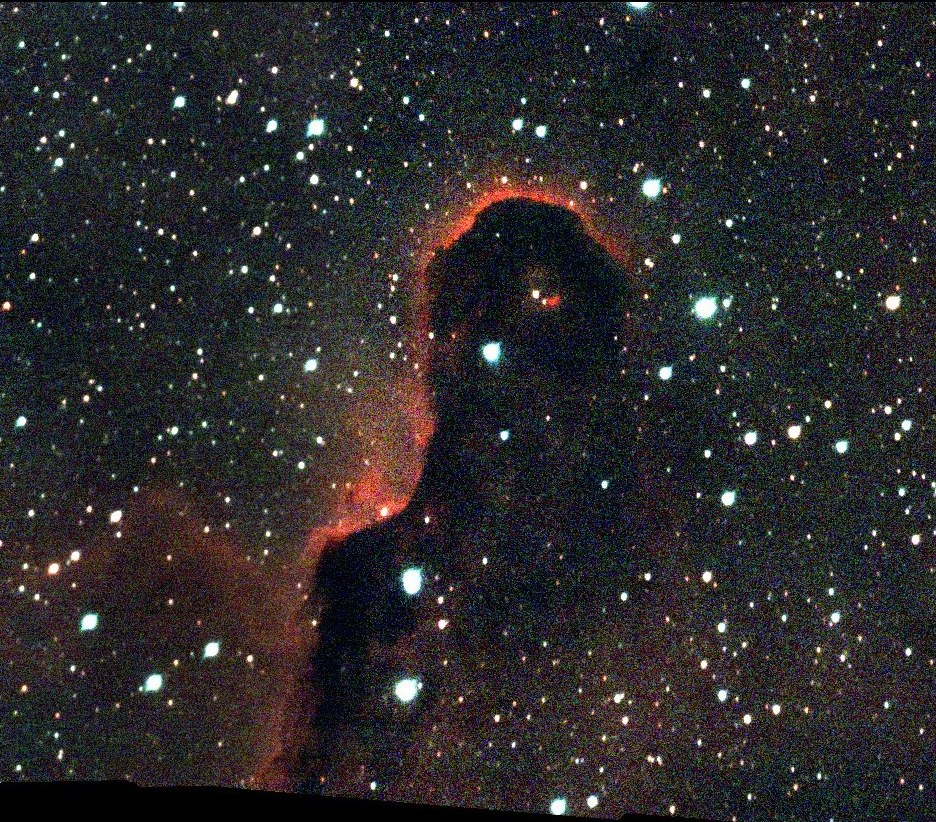
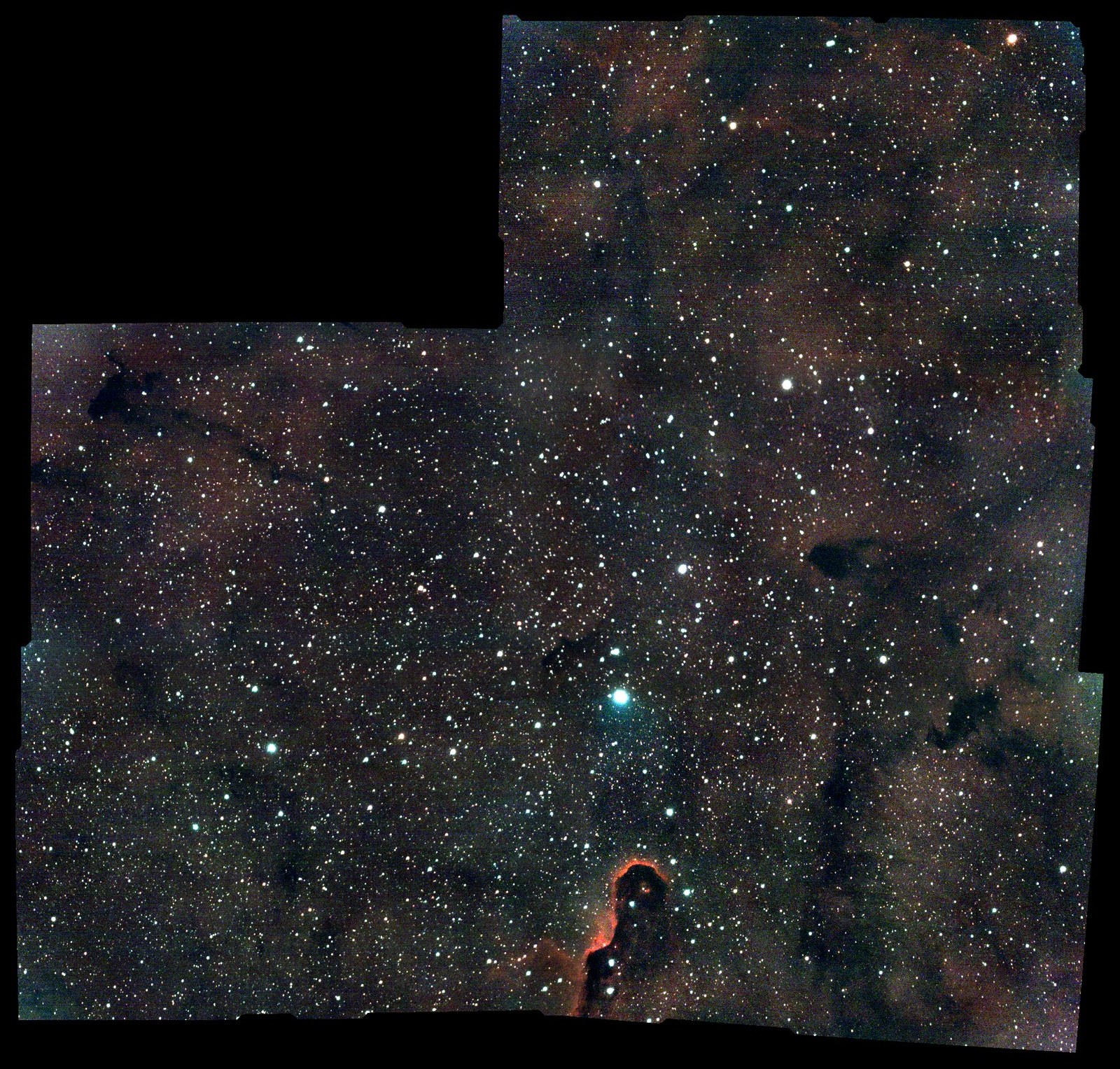
Im Sternbild Kepheus, hoch im Norden, hängt eine dunkle Wolke, die aussieht wie der Rüssel eines Elefanten. Sie gehört zu einem großen Nebel namens IC 1396. Das Bild oben ist ein Zwischenstand aus meiner Sternwarte in Vaale. Es besteht aus mehreren Stunden Belichtungszeit. Die Bilder sind so gedreht, dass der Rüssel nach oben zeigt. Am Himmel liegt Norden dadurch teils unten.
Was diesen Nebel besonders macht
Der Rüssel leuchtet nicht selbst. Er ist ein Schatten: eine dichte Wolke aus kaltem Gas und Staub, die das Licht des Nebels dahinter verschluckt. Sie ist rund 20 Lichtjahre lang.
Der rote Rand an ihrer Spitze ist dagegen echtes Leuchten. Mitten im Nebel steht ein sehr heißer, bläulicher Stern. Seine Strahlung trifft auf die Wolke, bringt das Gas an der Oberfläche zum Glühen und trägt sie dabei langsam ab. Man sieht also einen Kampf zwischen Stern und Wolke, der Jahrmillionen dauert.
Im Inneren der Wolke entstehen nach Messungen im Infrarotlicht neue Sterne. In meinem Bild ist im Kopf des Rüssels ein kleiner roter Fleck zu erkennen. Was genau er ist, kann ich daraus nicht sagen. Aber der Rüssel ist ein Ort, an dem gerade etwas anfängt.
Zwei Farben, die der Nebel selbst malt
Gas, das von einem Stern angestrahlt wird, leuchtet nicht in allen Farben, sondern nur in ganz bestimmten. Wasserstoff sendet ein tiefes Rot aus, Wasserstoff-Alpha oder kurz Ha (Wellenlänge 656 Nanometer). Sauerstoff strahlt blaugrün (OIII, 501 Nanometer).
Mein Filter, ein Optolong L-eXtreme, lässt genau diese beiden Farben durch und blockiert fast alles andere, auch das Licht von Straßenlaternen, Mond und dem allgemeinen Himmelsglühen. Dadurch tritt der Nebel auch am nicht ganz dunklen Himmel hervor. Dafür bekomme ich keine natürlichen Farben, sondern genau diese zwei.
Meine Kamera hat winzige Farbfilter vor den Pixeln, rot, grün und blau. Trennt man die drei Kanäle, zeigt sich, was vom Nebel in welcher Farbe ankommt:
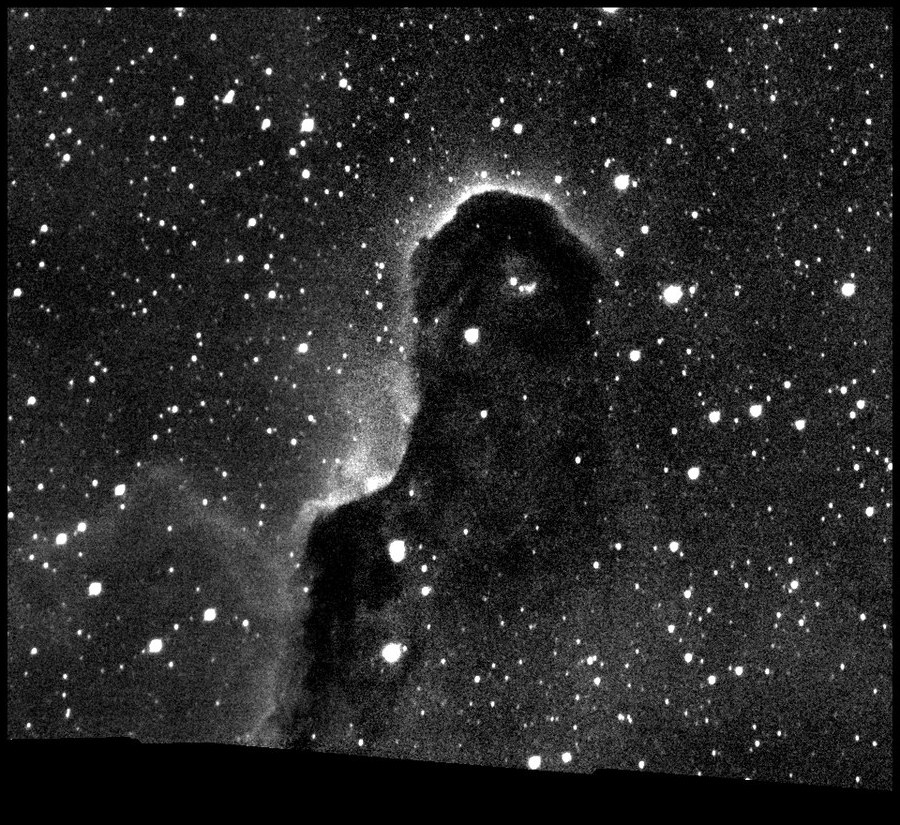
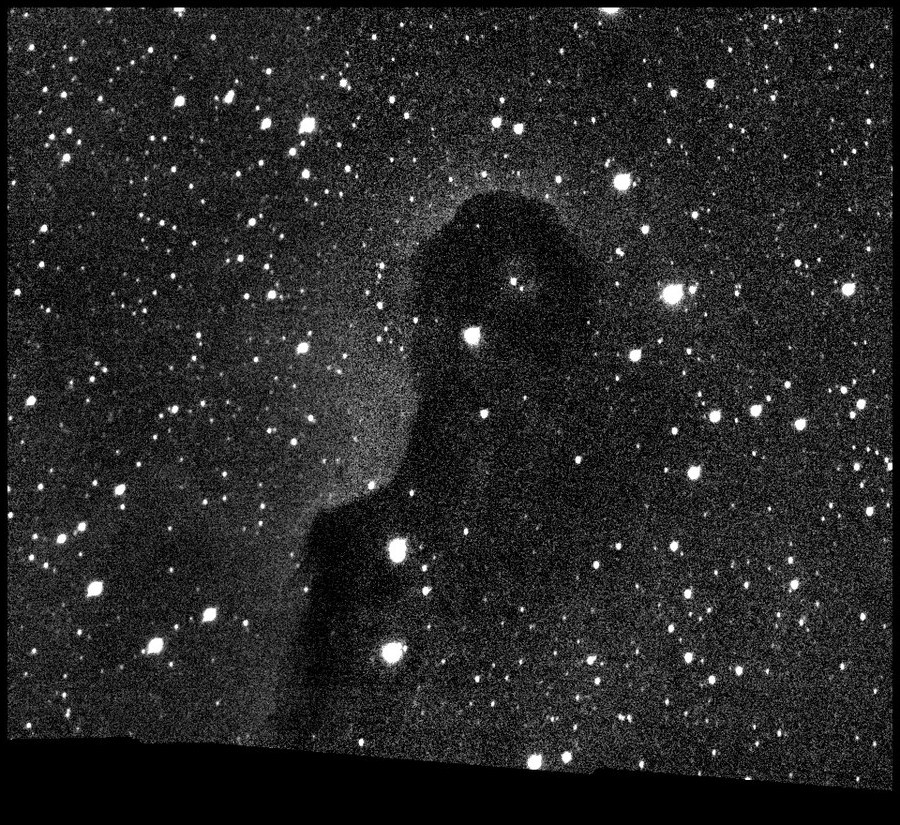
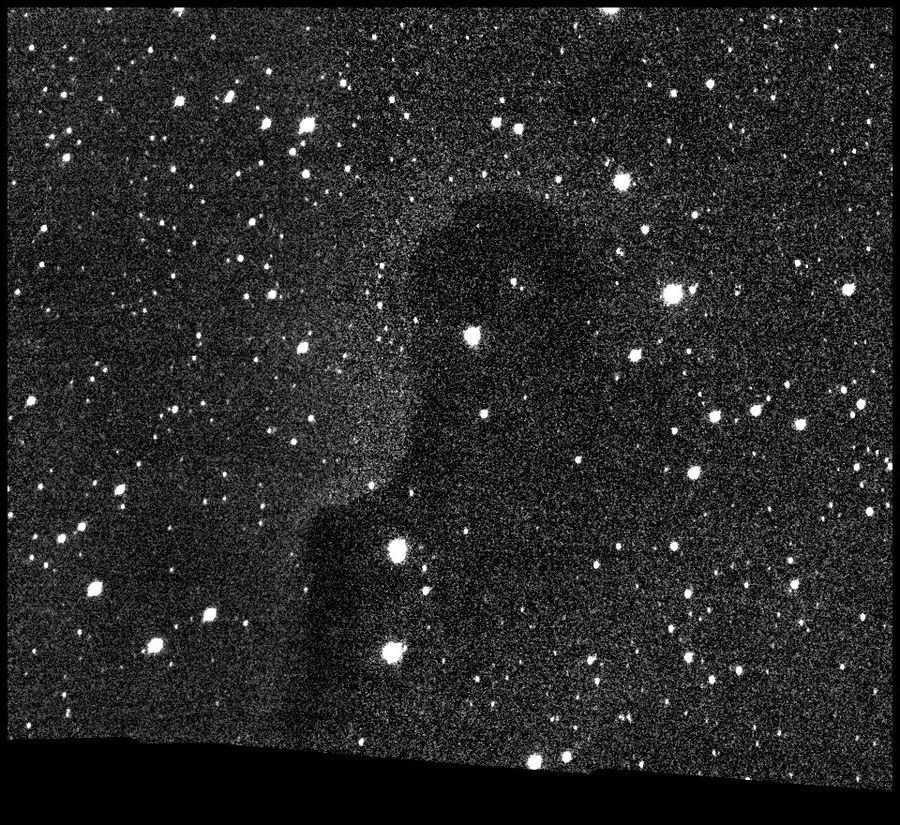
Hier sieht man, warum IC 1396 so rot wirkt: Es kommt fast nur Wasserstoff-Licht an. Im grünen und blauen Kanal bleibt vom Nebel wenig übrig, und der Rüssel zeichnet sich nur als dunkler Umriss ab.
Warum zwölf Felder
Mein Teleskop zeigt nur einen kleinen Himmelsausschnitt, 56 mal 37 Bogenminuten. Das ist gut doppelt so breit wie der Vollmond und eine feine Auflösung für die Details am Rüssel. Der ganze Nebelkomplex ist aber mehr als vier Vollmonde breit.
Ich könnte ein Objektiv mit weniger Brennweite nehmen und alles auf ein Bild bekommen, dann wären die Feinheiten am Rand des Rüssels nur noch ein paar Pixel groß. Ich gehe den umgekehrten Weg: viel Detail, dafür zwölf Teilbilder in vier Spalten und drei Reihen, die ich hinterher zusammensetze.
Fünf davon sind fertig. So sieht der Zwischenstand aus, stark aufgehellt, damit der Staub sichtbar wird:
So sieht ein einzelnes Bild aus
Jedes Feld besteht aus vielen Einzelaufnahmen zu je fünf Minuten. Ein einzelnes davon sieht so aus, nur aufgehellt:
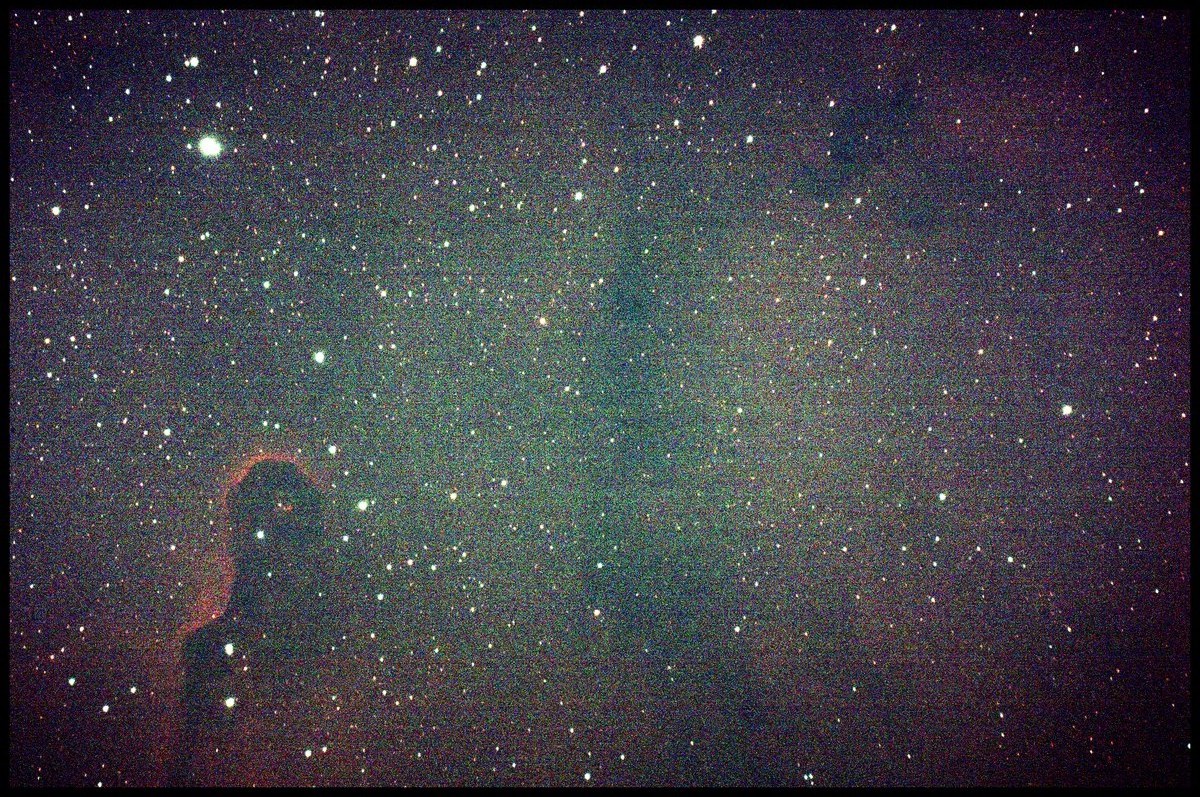
Das Rauschen mittelt sich heraus, wenn man viele solcher Bilder übereinanderlegt. Bisher sind es für die fünf fertigen Felder gut 110 Aufnahmen, zusammen gut neun Stunden Belichtungszeit, verteilt auf drei Nächte. Dazwischen liegen Wolken, Vollmond und Wochen, in denen nichts geht.
Wie es weitergeht
Als Nächstes kommen die übrigen sieben Felder an die Reihe. Danach rechne ich alles zu einem Bild zusammen und zeige es in der Astro-Galerie. Wie die Nächte dazwischen aussehen, kannst du jederzeit auf der Allsky-Kamera ansehen.
The Elephant’s Trunk in a mosaic
In the constellation Cepheus, high in the north, hangs a dark cloud that looks like an elephant’s trunk. It belongs to a large nebula called IC 1396. The picture above is a work in progress from my observatory in Vaale. It is made from several hours of exposure. The images are rotated so that the trunk points up. In the sky, that puts north partly at the bottom.
What makes this nebula special
The trunk does not glow by itself. It is a shadow: a dense cloud of cold gas and dust that swallows the light of the nebula behind it. It is about 20 light-years long.
The red rim at its tip, on the other hand, is real glow. In the middle of the nebula sits a very hot, bluish star. Its radiation hits the cloud, makes the gas on its surface glow and slowly wears it away. So what you see is a fight between star and cloud that lasts millions of years.
Inside the cloud, infrared measurements show new stars forming. In my picture there is a small red spot in the head of the trunk. I can’t say from this what exactly it is. But the trunk is a place where something is just beginning.
Two colours the nebula paints itself
Gas that is lit by a star does not glow in all colours, only in very specific ones. Hydrogen emits a deep red, hydrogen-alpha or Ha for short (wavelength 656 nanometres). Oxygen shines blue-green (OIII, 501 nanometres).
My filter, an Optolong L-eXtreme, lets exactly these two colours through and blocks almost everything else, including the light of street lamps, the Moon and the general sky glow. That makes the nebula stand out even under a sky that is not completely dark. In return I don’t get natural colours, but exactly these two.
My camera has tiny colour filters in front of its pixels, red, green and blue. If you separate the three channels, you can see what arrives from the nebula in which colour:
This shows why IC 1396 looks so red: almost only hydrogen light arrives. In the green and blue channels little of the nebula remains, and the trunk shows up only as a dark outline.
Why twelve panels
My telescope shows only a small piece of sky, 56 by 37 arcminutes. That is a good two times as wide as the full Moon, and a fine resolution for the details of the trunk. But the whole nebula complex is more than four full Moons wide.
I could use a lens with a shorter focal length and get everything into one picture, but then the fine structure at the edge of the trunk would shrink to a few pixels. I go the other way: lots of detail, and in return twelve panels in four columns and three rows, which I stitch together afterwards.
Five of them are done. This is what the work in progress looks like, stretched strongly so that the dust becomes visible:
What a single frame looks like
Each panel consists of many individual exposures of five minutes each. A single one looks like this, just brightened:
The noise averages out when you stack many such frames. So far, the five finished panels add up to a good 110 exposures, a good nine hours of exposure time in total, spread over three nights. In between there are clouds, full Moon and weeks when nothing works.
What happens next
Next up are the remaining seven panels. After that I combine everything into one picture and show it in the astro gallery. You can see what the nights in between look like at any time on the allsky camera.